Art Capital
COMING JAN 13, 2026 FROM STANFORD UNIVERSITY PRESS
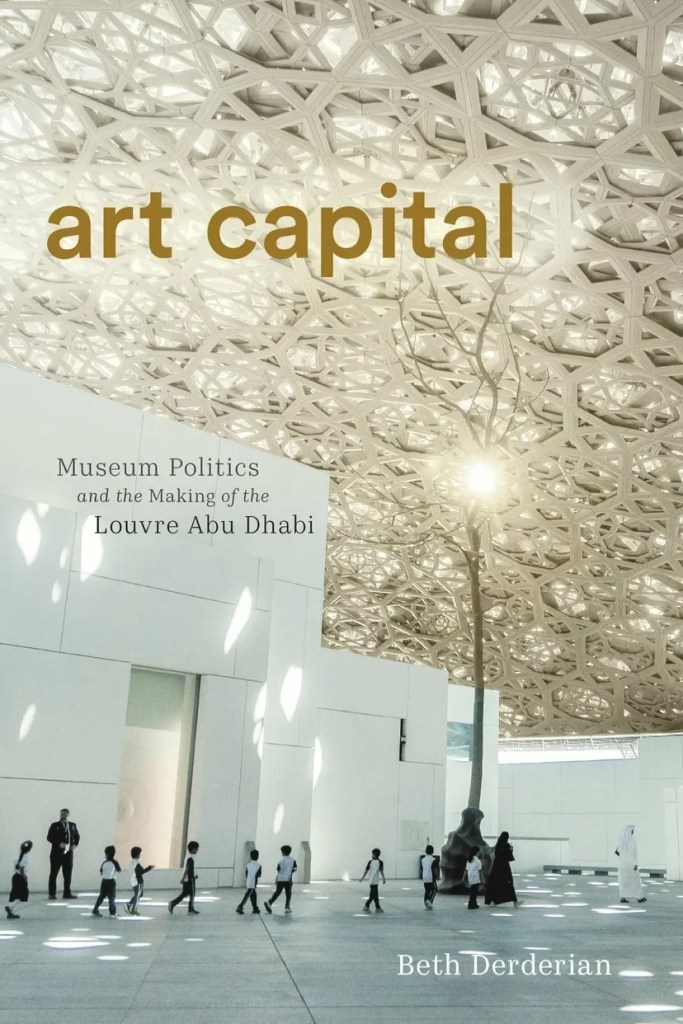
In 2006, the government of the United Arab Emirates (UAE) announced plans to build a Louvre and a Guggenheim off the coast of their capital city, Abu Dhabi. The New York Times immediately labeled these plans a “cultural Xanadu” and a group of French curators accused the Louvre of “selling its soul.” As the projects progressed, New York City-based labor activists staged protests, calling attention to the rampant abuse of migrant workers in the UAE and advocating for better treatment of those building the Gehry-designed Guggenheim and Nouvel-designed Louvre. To say the Louvre Abu Dhabi (now open) and Guggenheim Abu Dhabi (under construction) have been controversial is an understatement.
Despite the apparent novelty of such museum franchising, the underlying tensions that inflamed the controversy have deep roots. Analyses of museums and arts organizations at the turn of the last century have identified two issues: first, the increasing entanglement of art and museums with capital interests; and second, the need to diversify and decolonize museums’ staff, holdings, and the art world more generally. This push for inclusiveness is partly to accommodate multicultural 21st century publics and partly to rectify significant injustices in prior museum collection and representation practices.
The intersection of these two forces – increasing imbrication with capitalization and moving toward inclusivity – creates a fundamental tension: to achieve maximum reach, as a capitalist entity, museums and arts organizations must appeal to as many audiences as possible – yet simultaneously, they must represent vast constituencies with specificity (predicated on an assumption that representation attracts that community to the museum). The more specific the display, the less representative the museum becomes and ostensibly less broadly relevant. This dialectic, balancing universalism versus particularity, gaining maximum public reach while appealing to various community groups, reorganizes fundamental elements of museum practice in ways that are distinctive to 21st century museums and diverge from the prevailing models of 19th and 20th century museum practice.
Art Capital is a full-length ethnography, arguing that the UAE case reveals an emergent cultural logic of the 21st century art world. The book focuses on the decade between the Louvre Abu Dhabi announcement and its eventual opening in 2017. The book analyzes how these major shifts away from the 19th and 20th century paradigm of culture-state representation play out in museums’ and artists’ everyday practices, showing how this emergent paradigm may shape cultural production in the 21st century. The first major shift is in the relationship to the state and to money. In this 21st century paradigm, capital comes to eclipse the state as the primary nexus of power in the museum, causing formerly state-centric organizations to become hybrid, transnational entities. Patterns of state representation subsequently shift as capital supercedes the state, artists’ citizenship status plays into representation projects in new ways, serving to prove tolerance or multiculturalism. The twinned forces of capitalization and inclusivity also lead organizers to redefine what constitutes ‘good art’, and to establish a set of behaviors and concepts deemed ‘professional.’ In addition, these intersecting forces also spur a practice of pre-emptive erasures that neutralize and depoliticize difference for museum publics. These shifts all derive from this tension of maximal capitalist reach with an increasing need to accommodate, attract and represent diverse constituencies, and the Emirati art world offers a microcosm of these epistemic shifts.
Excavating Pella
Dubai-based graphic artist Azim al Ghussein and I are co-writing a graphic novel about the College of Wooster’s 1967 excavation at Pella, Jordan. Taking inspiration from true events, the novel follows a student excavator who worked at the site in 1967, and returned to dig again in 2017. Aimed at problematizing knowledge-making and expertise, the form of the graphic novel is an intentional attempt to make such questions accessible to a broad audience.
Project status: submitted for review
Arresting Objects
This book is about possession in the concrete, and repatriation in the abstract. Divided into four parts, this manuscript tells the stories of objects that were taken under wartime exception, challenging ideas of what constitutes legitimate transfer versus what constitutes plunder or looting. Case studies include state seizures of “enemy assets,” targeting in particular the personal belongings of foreign nationals; sale of objects from countries known to be at war; and the export of archaeological artifacts from countries during war.
Project status: research underway; drafting
 Beth Derderian